Table of contents
Forestry is entering a decade of pressure, and reinvention, as wildfires intensify, biodiversity rules tighten, and timber markets stay volatile while landowners are asked to prove, not just promise, responsible management. Across Europe and North America, agencies and companies are moving beyond “more data” to “better service”, bundling monitoring, planning, compliance, and financing into packages that can be deployed fast. The most consequential shift is not a new gadget in the canopy, but the way organisations are redesigning support around the people who manage forests every day.
From timber to “managed outcomes”
What are foresters really selling now? Increasingly, it is not only cubic metres of wood, but verified outcomes such as lower fire risk, higher carbon storage, healthier habitats, and stable local jobs, and that transition is pushing service innovation to the centre of the sector. Regulators and investors want traceability and proof, and the public has become far less tolerant of vague sustainability claims, especially as heat records, smoke events, and storms make forest health a mainstream concern rather than a specialist topic.
That shift is visible in the policy numbers. The EU’s updated LULUCF framework sets a higher net carbon-removal target for 2030, and it compels member states to translate that ambition into land-based accounting, reporting, and verification. In the United States, the Inflation Reduction Act earmarked roughly $5 billion for forest resilience and wildfire risk reduction, and it expanded funding channels that require measurable delivery. When money and compliance hinge on reporting quality, services that help land managers plan, document, and demonstrate progress stop being “nice-to-have”, and they become operational essentials.
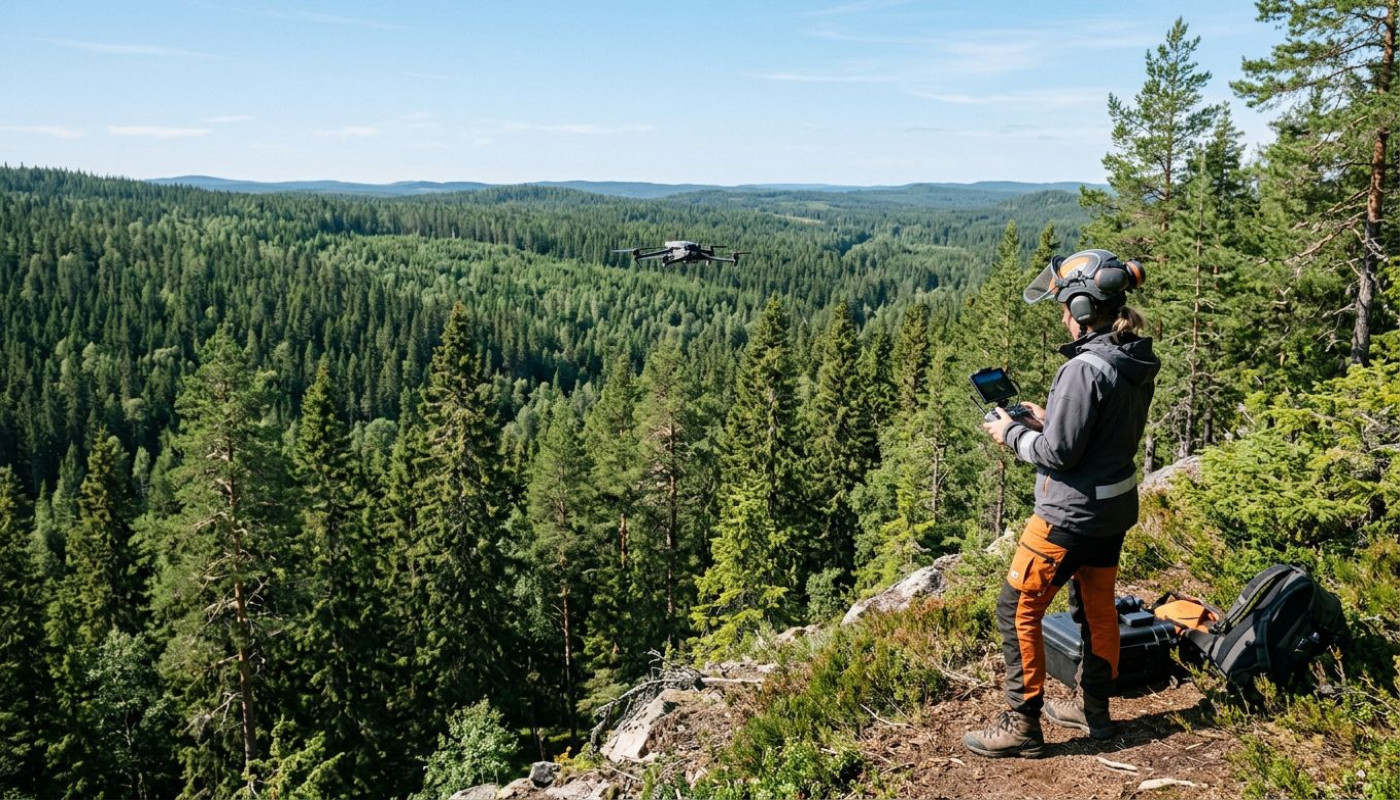
In practice, this is changing contracts. Instead of one-off purchases, forest owners are buying multi-year packages that combine remote sensing, on-the-ground inventories, and decision support, and they expect those tools to fit into daily workflows rather than add more paperwork. The service layer matters because the raw technologies already exist, satellites revisit the same landscapes every few days, drones can map stands at centimetre resolution, and sensors can track moisture and growth, but without a usable process for turning those signals into actions, the value leaks away.
That is why outcome-based forestry is driving demand for integrated service models: advisory teams that interpret data, platforms that keep documentation audit-ready, and financing partners that can underwrite restoration or thinning programmes. When timber prices dip or storms hit, these service systems help owners keep a long-term plan, and they also help buyers, from sawmills to corporate carbon purchasers, trust what they are paying for.
Digital monitoring becomes a daily utility
Forests do not wait for annual reports. Wildfire risk can spike in a week, pests can move across a region in a season, and drought stress can undermine growth long before a forester sees it from the road, so the service innovations gaining traction are those that turn monitoring into a routine utility, not a special project. Satellite imagery, LiDAR, and machine-learning classification are being packaged into subscriptions that deliver alerts, maps, and recommended actions, and the better services are designed to be understandable to non-specialists who still carry legal responsibility.
There is hard evidence that the monitoring stack is maturing. The European Space Agency’s Sentinel constellation provides free, high-frequency imagery that many services use as a baseline, and in the United States, the Forest Service has expanded its use of remote sensing for wildfire risk and post-fire recovery assessments. Meanwhile, aerial LiDAR, once limited to flagship projects, is becoming more common as regional programmes spread costs, and that makes terrain, biomass, and canopy structure far easier to measure and to compare over time.
The innovation is not only technical; it is procedural. Modern services increasingly offer “human-in-the-loop” quality checks, where algorithms flag anomalies, but experienced analysts validate them, and that hybrid approach matters because a false alarm can trigger unnecessary interventions while a missed signal can become a disaster. A landowner does not need a dashboard with fifty layers; they need a credible alert, a map that matches what they see in the field, and guidance that aligns with local rules and ecology.
What changes most for day-to-day forestry is speed. After a windstorm, a service can map blowdown quickly and help prioritise salvage operations while conditions still allow access, and after a fire, it can support damage assessment for insurance and public funds, and it can track regeneration in subsequent years. In regions where bark beetles or other pests are a chronic threat, earlier detection can reduce losses and the scale of sanitation logging. When monitoring becomes routine, it also becomes easier to communicate with stakeholders, from local communities to auditors, because the evidence is updated, consistent, and shareable.
Some providers are also layering in operational services: contractor coordination, documentation of thinning or fuel breaks, and scheduling that accounts for weather windows. For readers looking at how the service ecosystem is evolving beyond pure software, a useful reference point is see here, which illustrates how forestry-adjacent services are being bundled to answer practical needs rather than showcase isolated tools.
Carbon markets force credibility, and paperwork
Who pays for forest restoration at scale? Carbon finance is often presented as an answer, yet it has also become a credibility test, and that is where service innovation is accelerating fastest, because projects live or die on measurement, reporting, and verification. The scrutiny is not theoretical. In 2023, an investigation by The Guardian, Die Zeit, and SourceMaterial raised serious questions about the climate value of many rainforest offsets, and the controversy pushed buyers to demand stronger evidence, clearer baselines, and tighter permanence claims.
Services are responding by professionalising MRV. Better programmes rely on transparent methodologies, third-party verification, and monitoring plans that combine field plots with remote sensing, and they increasingly include risk buffers and long-term stewardship commitments. The administrative burden is heavy, and it is a barrier for smaller landowners, so intermediaries have started to offer “carbon project as a service”, handling feasibility, registration, monitoring, and credit issuance while the owner focuses on management. This is not only about selling credits; it is also about ensuring that claims survive audits and reputational scrutiny.
Regulation is pushing in the same direction. The EU’s Corporate Sustainability Reporting Directive is expanding the number of companies required to disclose climate-related information, and it raises expectations on data quality across supply chains. Even when a forest owner is not directly subject to those reporting rules, buyers may be, and they will ask for documentation that stands up to due diligence. Services that can translate forest data into compliance-ready narratives, with traceable sources and clear assumptions, are becoming the bridge between the woods and the boardroom.
The sector is also learning that permanence is a service problem. Fire, drought, and disease can reverse carbon gains, and insurance products, pooled risk buffers, and adaptive management plans are becoming part of carbon-related service bundles. Instead of treating monitoring as an afterthought, credible programmes build it into the economics, because confidence is what keeps demand alive. For many landowners, the practical question is whether the administrative cost and long-term obligations are worth the revenue, and that depends heavily on service design: streamlined workflows, fair fee structures, and realistic management requirements.
Workforce shortages reshape forest services
The biggest bottleneck is often people. Many regions face an ageing forestry workforce, tight labour markets for field crews, and rising competition for skilled technicians who can blend ecology with data, and those constraints are forcing service innovation to focus on usability, training, and labour efficiency. A tool that requires weeks of onboarding will fail in a small organisation, and a platform that cannot work offline will frustrate crews who spend days without stable connectivity.
Service providers are adapting in three ways. First, they are simplifying interfaces and automating routine tasks such as stand delineation, volume estimation, and compliance checklists, so a forester can spend more time on judgement and less on data entry. Second, they are offering training as part of the package, including short modules for seasonal staff, and refresher support during high-risk periods like fire season. Third, they are building collaboration features that make it easier to coordinate with contractors, conservation groups, and public agencies, because modern forestry is rarely done by one entity acting alone.
There is also a safety dimension. Wildfire smoke, heat stress, and rugged terrain raise risks for field teams, and services that reduce unnecessary trips, or that help plan safer access routes, can have real value beyond efficiency. When remote assessments can narrow the scope of ground checks, crews can be deployed more strategically, and that matters as climate extremes turn routine operations into higher-stakes decisions.
Finally, the talent pipeline is changing what “good service” means. Younger professionals expect modern digital tools, but they also expect transparency about how algorithms work and how data will be used, and that is pushing vendors to publish clearer documentation and to offer governance options. At the same time, experienced foresters bring local knowledge that models often miss, so the most effective service innovations are those that respect that expertise, capturing it in workflows rather than trying to replace it. In a sector built on long time horizons, the winning services will be the ones that help teams make defensible decisions today, and still understand what they did ten years from now.
Practical next steps for forest owners
Before signing, ask for a pilot, define the budget over three years, and verify what is included: monitoring frequency, field support, compliance documentation, and data ownership. For funding, check public schemes for resilience work, restoration, and fire mitigation, and align the service plan with those eligibility rules. Book early for peak seasons; capacity, and contractor time, vanish fast.
Similar
How Climate Change Influences Coastal Property Investment Strategies?

Revolutionizing agriculture with drone technology and IoT integration

Demystifying ChatGPT: understanding the technology behind the Chatbot
